Home › Vía de la Plata
Stage guide · Holy Year 2027
Almost 1,000 km along the old Roman road that linked Mérida with Astorga: from Seville through Extremadura, Salamanca and Zamora, and from Granja de Moreruela along the Camino Sanabrés to Ourense and Santiago. Few pilgrims, long stages and a lot of history.
Work out your Camino
Move the slider to your pace. Suseia then splits the route into stages based on the albergues in each town, and you can adjust them by hand.
Each dot is a day of walking to Santiago.
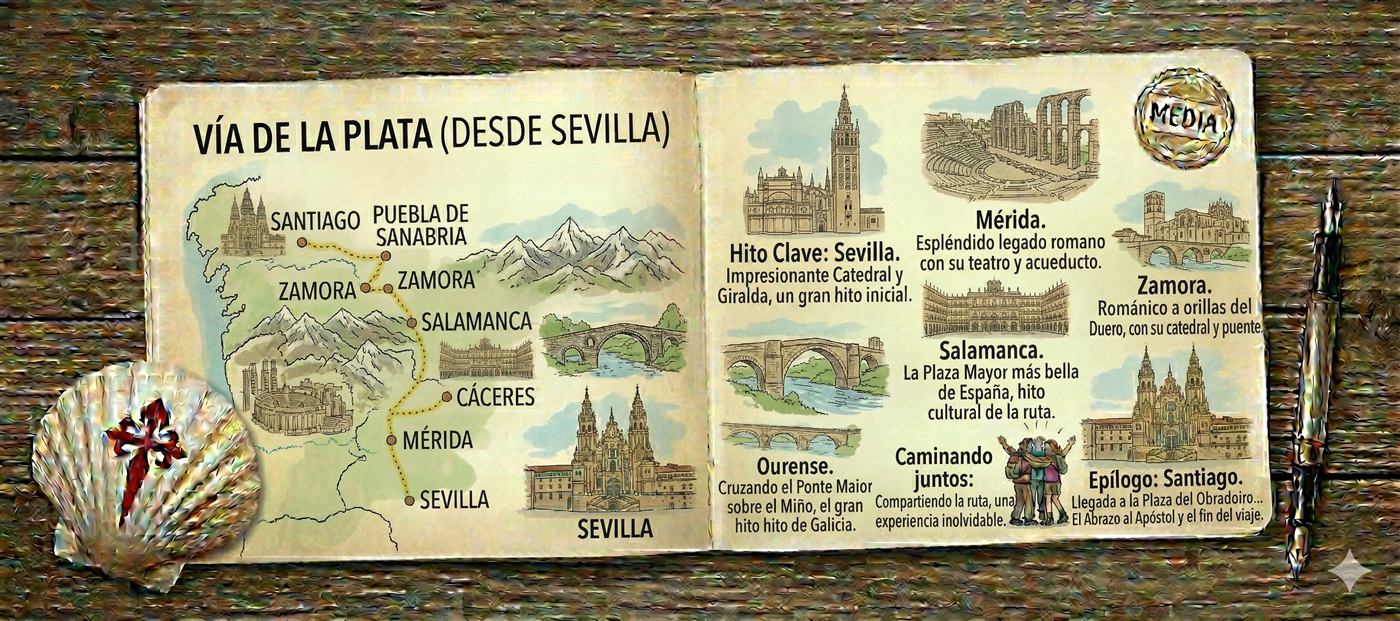
The route at a glance
Holm-oak dehesas and Iberian pigs in Andalusia and Extremadura, the Roman monuments of Mérida, the stone cities of Cáceres, Salamanca and Zamora, and the mountains of Sanabria before descending through Ourense to Santiago.
Stage by stage
The usual split via the Camino Sanabrés, which branches off at Granja de Moreruela. The original Vía de la Plata carries on to Astorga, where it joins the Francés.
From Seville to the Sierra Norte: Itálica, olive groves and the first dehesas. Long stages with few villages.
Endless dehesas, Zafra, Mérida and Cáceres, the Tagus reservoirs and the arch of Cáparra. Summer heat and long distances between villages.
The Béjar hills, Salamanca, Zamora and the Tera country to Puebla de Sanabria and the Padornelo pass.
You enter at A Canda. The hills of A Gudiña and Laza, Ourense and its hot springs, the monastery of Oseira and the Ulla valley to Santiago.
Distances are approximate: they can vary by a kilometre or so depending on the variant you take.
When to go
Spring and autumn are the best times: February to May and mid-September to November. In summer the heat in Andalusia and Extremadura often tops 40 °C and is dangerous.
Winter is mild in the south, but in Sanabria and on the way into Galicia there can be snow and ice.
2027 is a Holy Year. The Vía de la Plata will still be the quietest route, but some albergues are small: let them know before you arrive.
The Compostela
To get the Compostela you must walk at least the last 100 km. Ourense, the city of hot springs, is about 105 km from Santiago: five stages through Cea, the monastery of Oseira, Lalín and the Ulla valley.
It is a peaceful way to walk the last 100 km, far from the crowds of the Francés.
Start with the Ourense – Cea stage →Common questions
About 990 km from Seville to Santiago via the Camino Sanabrés, and a little more via Astorga.
Between 40 and 45 days at about 23–25 km a day. Many people walk it in sections over several years.
In summer, yes: there are stages of over 30 km with no villages or shade. Avoid July and August in Andalusia and Extremadura.

Choose where you start and how many kilometres you want to walk each day. Suseia builds your plan all the way to Santiago, free and without signing up.
 Suseia